
Why Employee Satisfaction Has More to Do With IT Than You Think

Imagine starting a new role where the tech just works. Your laptop is ready to go, files are easy to find, software workflows make tasks a breeze, and IT has your back when you need it. It seems like a no-brainer, yet organizations often overlook good technology setups as part of the employee experience.
Engagement and retention are often treated as HR or culture problems first. But now, IT decisions are just as important in user satisfaction. When staff must constantly wrestle with tool sprawl, legacy systems, and clunky integrations, it’s easy to see how digital workspaces can lead to burnout and low performance.
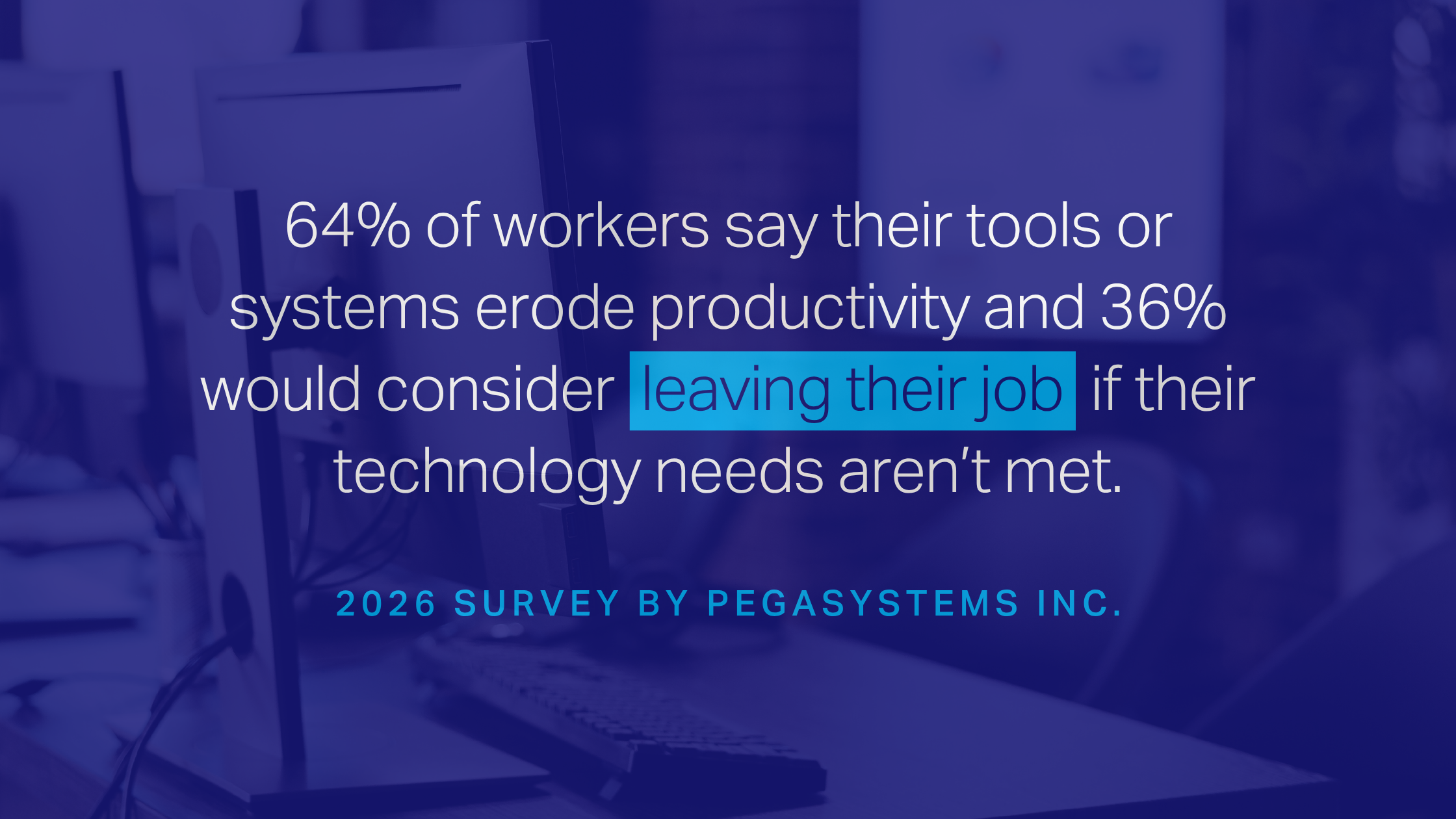
It’s a connection that’s supported by the research: In a 2026 survey of over 2,600 workers, 64% say their tools or systems erode productivity, and over a third would consider leaving a job with bad tech.
If your organization is struggling with workplace satisfaction, it can be helpful to rethink the problem through an IT and systems lens. Here, we’ll cover why the connection between employee engagement and technology matters, and what an effective environment looks like.
The Impact of Technology on Employee Productivity
Work today is defined by efficiency and rapid disruption. Organizations are under intense pressure to deliver results quickly, keep pace with innovation, and do more with less. For many employees, though, day-to-day work doesn’t actually feel that productive. Instead of staying focused, staff are constantly sidetracked by distractions and frustrating tools.
Microsoft states that the average employee receives over 100 emails a day and is interrupted every two minutes. Each week, staff spend 11+ hours in meetings and one hour just toggling between platforms. While context switching is the norm, it not only affects progress but also makes people feel more stressed.
On top of that, most organizations still use legacy systems, like desktop-only apps, unintuitive UX design, or software that’s incompatible with new tools. That shifts even more time and energy away from real tasks towards figuring out how to make systems function cohesively. When companies do introduce new tech, only about half of employees say it actually meets their needs.
The obvious cost here is financial, as companies pay in lost productivity and employee turnover. Over time, technology gaps can also impact culture and reputation. These factors make it harder to attract new talent, especially younger generations. A 2025 Deloitte survey shows that around 80% of Gen Z and millennial workers rely on modern tech like generative AI (GenAI) to improve work quality and work/life balance.
The Productivity-Satisfaction Feedback Loop
Addressing the problem starts with understanding what drives employee satisfaction in the first place. It’s true that employee well-being naturally leads to better performance, with Deloitte research showing that satisfied workers are twice as productive.
But that’s only half the story. While satisfied employees are more productive, the research explains that greater productivity also boosts employee satisfaction in a continuous feedback loop. What’s more, some of the biggest productivity differentiators involve reducing “work about work”—the energy required to app switch and manage messy systems.
For IT departments, the key takeaway here is that well-designed environments are the best way to reduce busywork and enable that productivity-satisfaction cycle. While HR and culture-based strategies are also important, employee experience is largely shaped by the systems staff interact with every day.
What A Strong Digital Employee Experience Looks Like
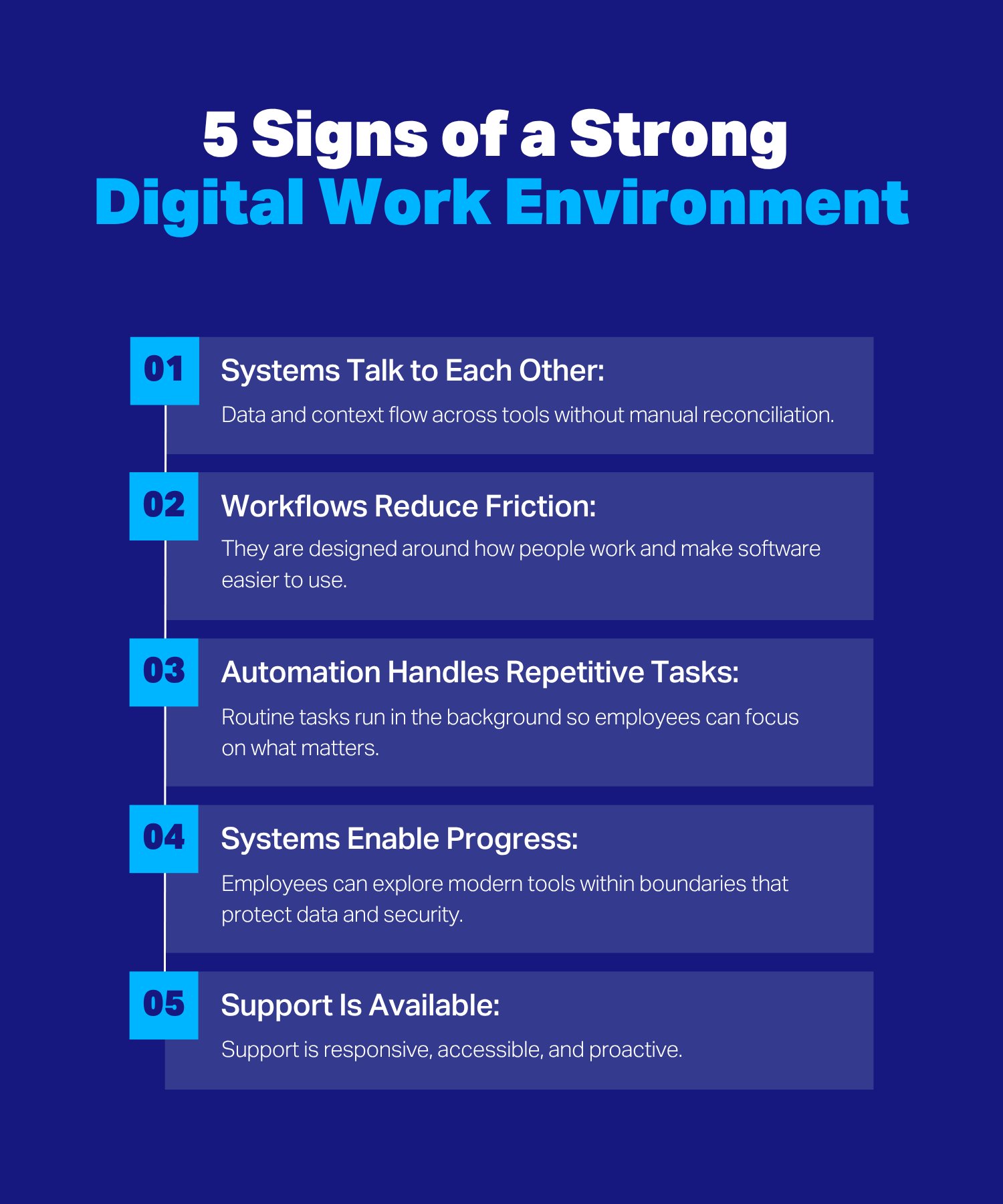
Incremental changes in your IT environment can have an outsized impact over time, moving teams from simply getting through the day to getting meaningful work done. Here are some signs of a strong digital work environment to strive for—one that reduces “work about work” and supports employee engagement:
1. Systems Talk to Each Other
In an ideal tech stack, systems are integrated so that data, context, and actions connect. Users don’t need to think about where information lives and manually reconcile tasks between tools. Platform switching doesn’t feel like “starting over” each time, and users aren’t required to enter the same data in multiple places.
For example, imagine a connected Microsoft 365 environment: a file shared in Teams is automatically stored in SharePoint with version history and permissions already set; meeting notes in OneNote link directly to calendar events in Outlook; and user access is unified via Entra ID, so employees aren’t juggling multiple logins or permissions.
2. Workflows Are Designed to Reduce Friction
While integrations help data seamlessly connect across environments, good process design also makes software easier to use. Platforms should reflect how people actually work, rather than forcing people to adapt processes to the technology.
IT teams that succeed here identify common sticking points in routine tasks—like adding prospects to a CRM or onboarding staff—and making adjustments. This could mean redesigning workflows to cut unnecessary steps and introduce more process-driven interfaces. Controls like multi-factor authentication (MFA), which often interrupt the flow of work, could also be applied more intelligently through techniques like adaptive authentication.
3. Automations Free Employees From Repetitive Tasks
A closer look at everyday workflows usually reveals areas where automations can make immediate improvements. Research from Salesforce shows that 3 out of 4 employees report lower stress at work, and nearly 90% say they’re more satisfied in their roles as a direct result of automation.
Some common, low-barrier automations include:
Approving routine forms like time-off requests or expenses
Onboarding employees through workflows that create accounts, assign access, and notify stakeholders
Managing shared file systems, including tagging or controlling access based on predefined rules
Creating tasks and reminders based on communications from emails, forms, or CRMs
Updating records across systems to avoid duplicate entry and keep data consistent
4. Systems Enable Progress (Within Guardrails)
Automations naturally open the door to GenAI, copilots, and other intelligent platforms. According to a Microsoft survey, 70% of staff are eager to offload as much work as possible to AI.
That said, adoption works best with clear constraints. Users should be able to explore and benefit from AI, but with limitations that protect data and enforce appropriate use. At a basic level, that looks like:
Starting with data that’s clean, labelled, and structured
Applying least privilege access to both users and AI systems
Defining how employees can use AI and which tools are approved
Maintaining visibility into AI usage and outcomes
In reality, employees won’t wait for perfect AI governance. If official solutions aren’t available or easy to use, they’ll take adoption into their own hands. The best environments make it easy for employees to experiment while IT maintains control over data, security, and overall impact.
5. Support Is Available When Users Need It
Even with strong systems, staff can lose momentum if help isn’t there when something goes wrong. Support should be responsive and built into the flow of work where possible.
In practice, that means new hires have the tools they need from day one. IT is consistently available through service desks, chats, or ticketing systems. Common requests, like password resets or basic troubleshooting, are handled through self-service with documentation that’s easy to find and interpret.
Behind the scenes, IT interactions also feed continuous improvements. The IT department tracks recurring issues and friction points to refine systems and streamline the digital employee experience over time.
IT Belongs In the Culture Conversation
As workplaces become more digital, IT is no longer a behind-the-scenes function but plays a key role in how people feel at work. Through thoughtfully designed systems that reduce friction, organizations can directly reinforce staff performance and overall satisfaction.
While changing the technology itself is necessary to reach those goals, it’s also about a mindset shift. Employee well-being has traditionally been treated as an HR responsibility, so organizations must work to reframe what people and culture priorities look like from an IT perspective.
Companies that can successfully make this connection will be better positioned to increase productivity, foster innovation, and create an environment that people genuinely want to be a part of.
IX Solutions can help evaluate your IT environment and find opportunities to improve the employee experience. Reach out to learn where small changes will have the biggest impact.
