
What a Strong Security Posture Really Looks Like—and Why It Matters

With rapid AI advances and constant change across the IT landscape, it can be easy for even experienced security professionals to lose clarity on what matters. New tools, frameworks, and priorities emerge faster than most organizations can realistically adopt. Over time, security efforts can start to feel scattered.
For CIOs and IT leaders, the challenge often isn’t a lack of awareness, but a lack of strategic and practical alignment: What does a strong security posture really look like, and what concrete steps can the organization take to move toward it?
The reality is that security posture isn’t defined by a single initiative or toolset, but the outcome of a holistic program. Security, at its best, functions as an operating model to support ongoing business resilience and growth, not a point-in-time project.
In this article, we’ll clarify what a good security posture looks like, explain why it matters for your organization, and outline practical cybersecurity best practices to underpin everyday operations.
What “Security Posture” Means
Security posture is a measure of an organization’s big-picture cybersecurity strength and readiness, indicating how well it can prevent, detect, and respond to threats. Those threats can target and impact your software, hardware, and data assets; security procedures and configurations; employee behaviour; and third-party vendors or service providers.
Importantly, security posture isn’t defined by any one initiative. Think of it as the cumulative outcome of how multiple elements work together over time, including:
Security policies and procedures
Technical controls, like patching and network protections
Employee behaviour and training
Why Security Posture Matters
Security is usually owned by IT, but its impact affects the entire organization. A weak posture can disrupt operations, erode trust, and introduce financial and regulatory risk. In other words, a strong posture isn’t just a defensive necessity, but can directly support business efficiency and growth.
Limit Financial Loss and Business Disruption
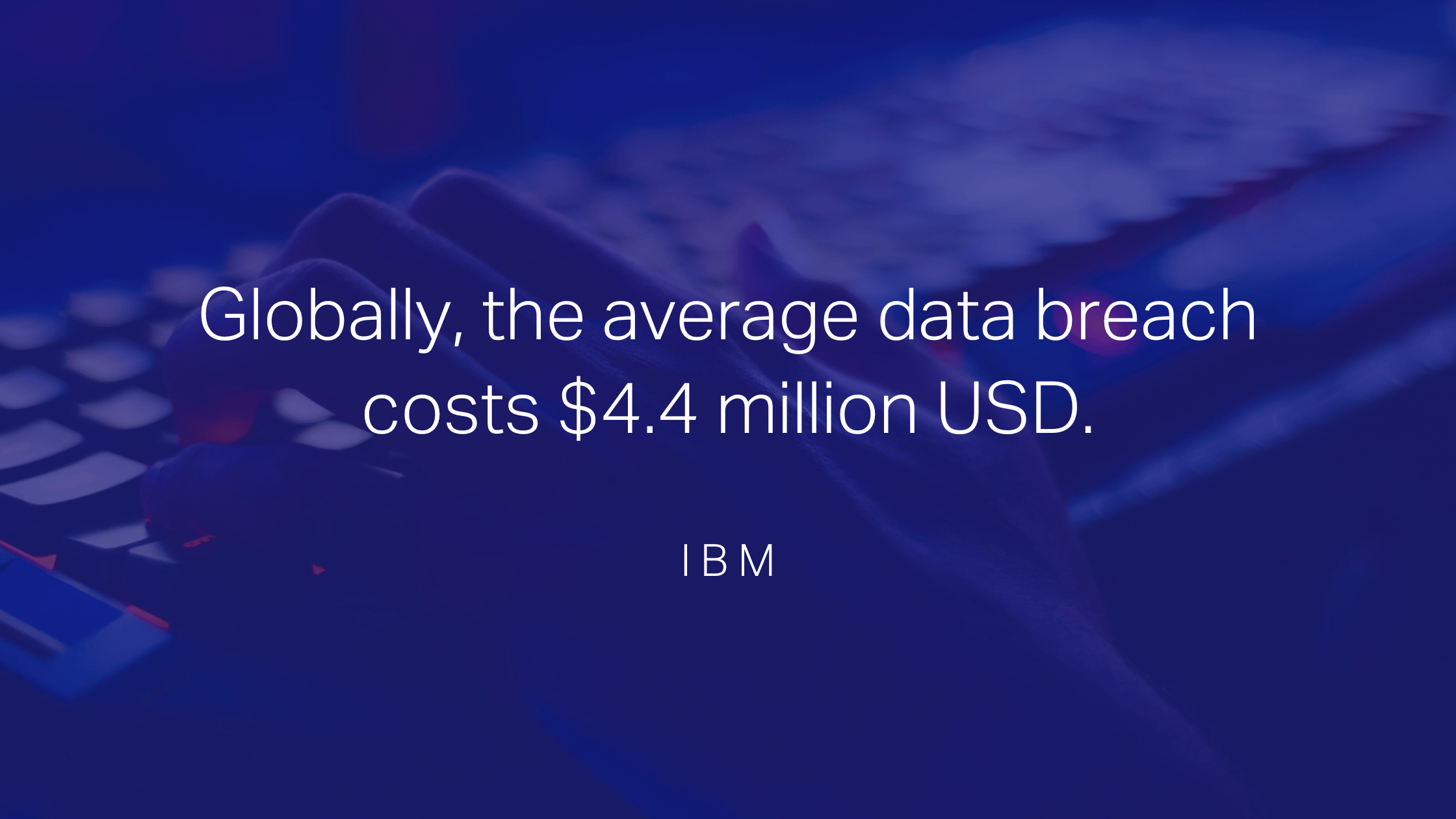
A healthy security posture lowers the chance and impact of incidents. According to IBM, the global average data breach costs $4.4 million USD. Organizations with mature postures can detect and contain risks earlier, limiting financial loss, operational delays, and reputation damage. Proactive programs also adapt more quickly as threats evolve, reinforcing business resilience over reactivity.
Embed Compliance Into Operations
Security posture plays a growing role in regulatory compliance. Data protection laws such as GDPR, CCPA, and PIPEDA now require businesses to demonstrate appropriate safeguards. A solid security posture makes compliance a natural outcome of effective operations, rather than a scramble to satisfy compliance checklists.
Reduce Risk Across Strategic Vendors and Partners
In its 2025 Data Breach Investigations Report (DBIR), Verizon found that the number of breaches involving a third party has doubled from 2024, from 15% to 30%. With a holistic security approach, organizations can take advantage of external tools and partnerships without blindly accepting added risk.
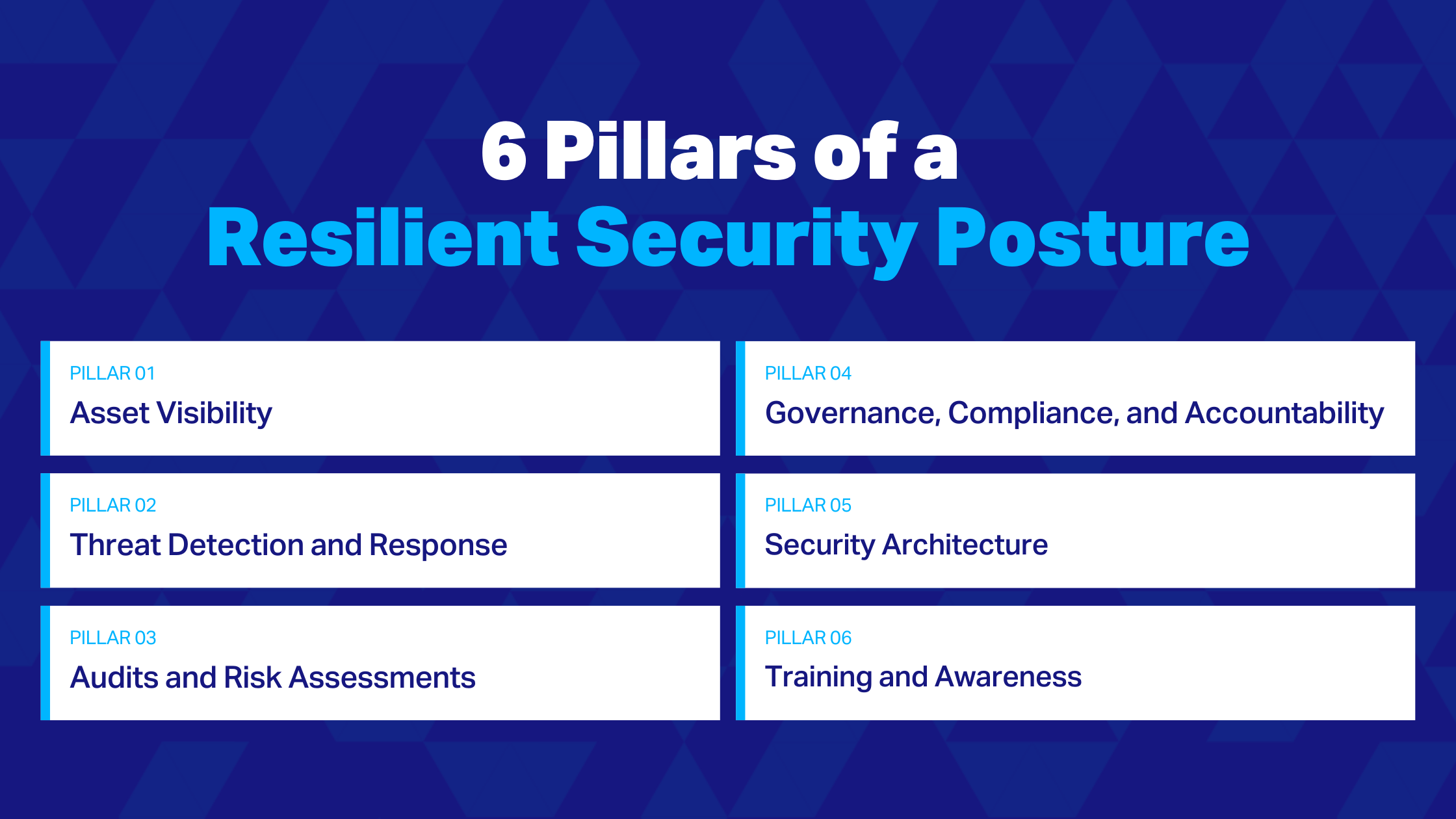
6 Pillars of a Resilient Security Posture
1. Asset Visibility
A good security posture starts with knowing what you actually have, including hardware (laptops, servers, networking equipment, mobile devices) and digital assets (cloud infrastructure, accounts, apps, third-party software, data). Even small changes in your assets—think shadow IT or new users—can quietly introduce risk.
Regular inventories can scale back hidden vulnerabilities. When IT knows exactly what systems, software, and data are in play, it can locate risks faster and implement proactive safeguards.
Third-party software deserves particular attention here. Many external tools operate with security controls that sit outside your control, yet still touch your systems or data. It’s crucial to understand where vendors are connected, what they can access, and what protections those providers use.
Equally important is data visibility. Many organizations handle far more sensitive information, like personal or financial records, than they realize. According to Varonis, 99% of businesses have sensitive data exposed to AI tools, and only 10% have properly labelled and classified their files. These gaps make it hard to protect information, stay compliant, or control how people use data.
2. Threat Detection and Response
When it comes to resolving security incidents, speed is everything. The faster suspicious activity is found and contained, the lower the financial, operational, and reputational impact. IBM’s 2025 Cost of a Data Breach Report shows that breaches taking under 200 days to remediate cost an average of $1.14 million less than those with longer life cycles.
Real-time monitoring and detection tools are central to this pillar, as well as clearly defined escalation procedures. Security information and event management (SIEM), security orchestration, automation, and response (SOAR), and endpoint detection and response (EDR) tools are commonly used to optimize visibility and remediation. Many of these solutions now use AI and machine learning to automate threat detection, helping cut false positives and shorten time to action.
3. Audits and Risk Assessments
While threat detection tools deliver real-time visibility, regular IT audits provide the broader context needed to evaluate and advance security posture over time. They’re valuable in pinpointing weaknesses and prioritizing mitigation efforts where they’ll have the greatest impact.
Integrating useful, relevant metrics into audits, such as detection timelines or industry benchmarks, helps evaluate security posture consistently and track progress. Audits should also document lessons from incidents, so IT has a reference point to update controls.
An effective audit should start by defining objectives and focus areas, with a thorough review of your asset inventory. Typically, audits and risk assessments use automated scans, manual analysis, and/or techniques like red teaming to analyze threats—then use those insights to prioritize risks and make improvements.
4. Governance, Compliance, and Accountability
Governance defines how security and data protection are enforced across the organization, translating regulatory standards into policies and procedures. Proper documentation is key here, helping establish accountability to regulators and other stakeholders when something goes wrong. Because data protection laws now cover over 160 global jurisdictions, organizations must understand which requirements apply and weave them into their security strategy.
Governance frameworks are defined by:
Policies and procedures: Define formal processes for how systems and data are classified, accessed, stored, shared, and protected.
Access controls and technical enforcement: Apply policies through security software, IT workflows, and techniques like role- or rule-based access controls.
Ownership: Establish clear responsibility for security decisions, risk acceptance, and escalation when issues arise.
Documentation: Demonstrate how controls are executed through accurate records.
5. Security Architecture
A strong security posture relies on carefully designed, layered, and integrated controls that work together to contain risk. Without a cohesive approach, it can be easy to accumulate point solutions that seem productive on paper but add complexity in practice. When tech stacks are intentionally coordinated, security becomes easier to manage, scale, and adapt over time.
Effective security architecture is guided by three foundational ideas. First, controls must be integrated so that tools share context and operate as part of a unified system. Second, access decisions should reflect a zero-trust model, continuously verified based on identity, device health, and contextual risk. Third, solutions must use a defence-in-depth approach. By thoughtfully layering controls, IT can limit the likelihood that one failure snowballs into a breach.
These principles shape how security is implemented across key security layers:
| Security Layer | Purpose | Examples |
|---|---|---|
| Endpoint security | Protect hardware and prevent compromised devices from becoming entry points |
|
| Network security | Monitor and control traffic to detect and contain suspicious activity |
|
| Cloud and application security | Secure cloud infrastructure and applications by controlling access, monitoring activity, and enforcing secure configurations |
|
| Data protection | Safeguard sensitive data at rest and in motion |
|
| Patch and configuration management | Keep systems and software up to date by applying patches and enforcing secure configurations |
|
6. Training and Awareness
Employees are a critical part of any security posture—whether it’s as a source of risk, or (ideally) as your first line of defence. Human error or misuse of access can expose organizations to threats just as easily as technical gaps. Verizon’s 2025 DBIR shows that nearly two-thirds of breaches involve a human element.
Ongoing training and awareness programs help employees recognize common adversary tactics like phishing and social engineering, reducing the likelihood that attacks succeed. They also reinforce everyday security practices, including careful password management, user authentication, and safe use of AI-based tools. When done well, employee education lowers overall risk and embeds security awareness beyond IT and into the company’s broader culture.
Practical Strategies to Mobilize Your Organization Around Security
Enforce Cybersecurity Best Practices
Strategies like building a layered security architecture can take time. However, enforcing a set of core cybersecurity best practices in your day-to-day operations will immediately decrease risk and contribute to your overall security posture:
Require multi-factor authentication (MFA) or passwordless authentication for all accounts, including email, cloud services, and remote access tools.
Mandate a password manager to improve password hygiene.
Automate software updates for operating systems, browsers, and applications to address known vulnerabilities.
Secure remote workspaces with approved VPNs and clear policies around public Wi-Fi use.
Apply zero-trust principles and least privilege access, setting up systems to continuously verify users and restrict access to only what each role truly needs.
Invest in a Security Training Program
With employee education established as a pillar of your security strategy, here are some guidelines to ensure the program actually delivers a return on investment:
Include security training in onboarding for all employees, not just IT.
Run short, regular refresher training focused on the latest risks, like new phishing or impersonation tactics.
Educate employees on escalation procedures.
Tailor training by user role and risk level, with special guidance for high-risk areas like finance and leadership.
Use simulations and exercises to reinforce real-world decision-making.
Provide special security training for AI-based tools.
Work With a Managed Security Services Partner
Managed security services help organizations maintain consistency and coverage, especially when your IT team already has a full plate. A reliable partner acts as a force multiplier, providing monitoring, expertise, and structured response without removing internal ownership.
They also bring a broader perspective to tool adoption, emerging threats, and shifting compliance requirements, enabling continuous improvements. Partners like IX Solutions work alongside your team to reduce operational lift while making measurable improvements to your security posture over time.
Elevate Your Security Posture With IX Solutions
Despite what it might seem like from cyber trend cycles and industry headlines, a solid security posture doesn’t come from adding more tools. It comes from bringing visibility, governance, architecture, and training into a cohesive operating model that evolves both with your business and the threat landscape.
If your IT space feels cluttered with overlapping solutions or disconnected initiatives, it might be time for a reset. IX Solutions partners with your team to cut through unnecessary complexity, rationalize your security stack, and align your investments around a clear, practical strategy that supports long-term business goals.
Ready to take a clearer, more strategic approach to your security posture? Learn more about our Cybersecurity Services or get in touch with our team to start building a roadmap.
