
AI Cyberattacks: How to Find and Address Security Gaps Before Attackers Do

In May 2026, Google identified what it believes was the first observed case of a threat actor using a zero-day exploit developed with AI. If you’re hearing more about AI cyberattacks like this, you might be wondering what those developments mean for your security strategy.
One of the biggest implications is speed. As AI helps bad actors move faster, organizations have less room to leave vulnerabilities overlooked.
“Attackers can essentially go from discovery to exploitation in hours or days, compared to the weeks or months we would’ve seen before AI took off,” says Eddie Moncada, Modern Security Consultant at IX Solutions.
Staying ahead starts with knowing exactly where your current weaknesses are. Vulnerability assessments and penetration testing are both valuable for uncovering gaps, prioritizing what matters, and checking whether your controls hold up in practice.
In this article, we’ll cover:
How attackers are contributing to evolving AI security risks
Common blind spots that could be exposing your organization’s assets
How a vulnerability assessment and penetration testing can be combined effectively
AI Cyberattacks Leave Less Time to Address Weaknesses
One of the primary ways AI is changing cybersecurity is by accelerating attack speeds. Mandiant data shows that mean time-to-exploit is -7 days, meaning that vulnerabilities are sometimes exploited before a patch is even available.
AI hasn’t, for the most part, introduced new types of attacks. However, it’s lowering the barrier to entry for adversaries and changing existing methods like social engineering and vulnerability chaining.
Social Engineering
While spelling mistakes or odd formatting might have rung alarm bells for users in the past, AI allows bad actors to quickly craft more polished phishing campaigns. Emails can look nearly identical to something you’d receive from a reputable vendor like Microsoft, while AI-generated voices and deepfakes can make other impersonation attempts more convincing, too.
“AI is making social engineering faster, cheaper, and a lot more believable,” Moncada cautions. “When it comes to actually seeing malicious AI show up day-to-day for our clients, the quality of social engineering has been the biggest observable change.”
Vulnerability Chaining
Vulnerability chaining involves combining multiple weaknesses to carry out a more complex and effective attack. For example, someone might gain initial access to a company’s environment through a vulnerable firewall, then discover unpatched devices or outdated software that enable a path deeper into the network.
Threat actors traditionally had to identify and connect these security flaws manually. Now, AI can automate much of that work, helping map out and execute a more effective attack path very efficiently.
Where Security Gaps Tend to Hide
Internet-Facing Assets
When chaining vulnerabilities, attackers often gain an initial foothold through internet-facing assets like a company website, firewall, or customer portal. Threat actors can discover and probe these systems quickly, cheaply, and repeatedly with AI. Organizations, especially those with limited IT or cybersecurity resources, may struggle to maintain full visibility over these assets, leaving them more exposed.
Permissions
Broad or misconfigured permissions—like having too many admins in the tenant or stale accounts that are still enabled—are common blind spots that can expose far more information than intended if an adversary gets into your environment.
According to Moncada, bringing AI solutions like Copilot into the mix can amplify that risk because they make existing access control problems easier to exploit.
“I’ve seen what can happen when least-privilege or just-in-time access principles aren’t followed,” he notes. “With the right query, Copilot can give employees sensitive documents or technical information like API keys, even if there’s no malicious intent there.”
If an account with overly broad permissions is compromised, the problem can escalate quickly. Before AI, attackers had to spend time determining what the user could access, searching through files and systems for useful information, and deciding how to best exploit it. An enterprise AI assistant can dramatically shorten that process by surfacing relevant content much faster.
Detection and Response Coverage
As AI compresses the attack cycle, organizations have less time to detect and respond to malicious activity. Traditional IT routines like monthly patching or reviewing security alerts only during business hours may no longer provide enough coverage. IT departments need processes and tools that allow them to identify and handle threats beyond the traditional nine-to-five window, including 24/7 monitoring and response capabilities.
Getting Ahead of AI Cyberattacks With Vulnerability Assessments and Penetration Testing
If AI is helping attackers find and exploit weaknesses faster, organizations need to get better at finding them first. That means shifting the focus from reacting to vulnerabilities to spotting and addressing them before they cause problems.
Vulnerability assessments and penetration testing approach that challenge from different angles. Used together, they can give organizations a clearer picture of their exposure and how to prioritize action items.
“There are still a lot of businesses that think of them as expenses,” points out Moncada. “In reality, proper assessments and pentesting are some of the most important investments you can make in the organization, especially as malicious AI evolves.”
Understanding the differences between these two strategies—and how they complement each other—can help IT teams determine where each fits within their security program and budget.
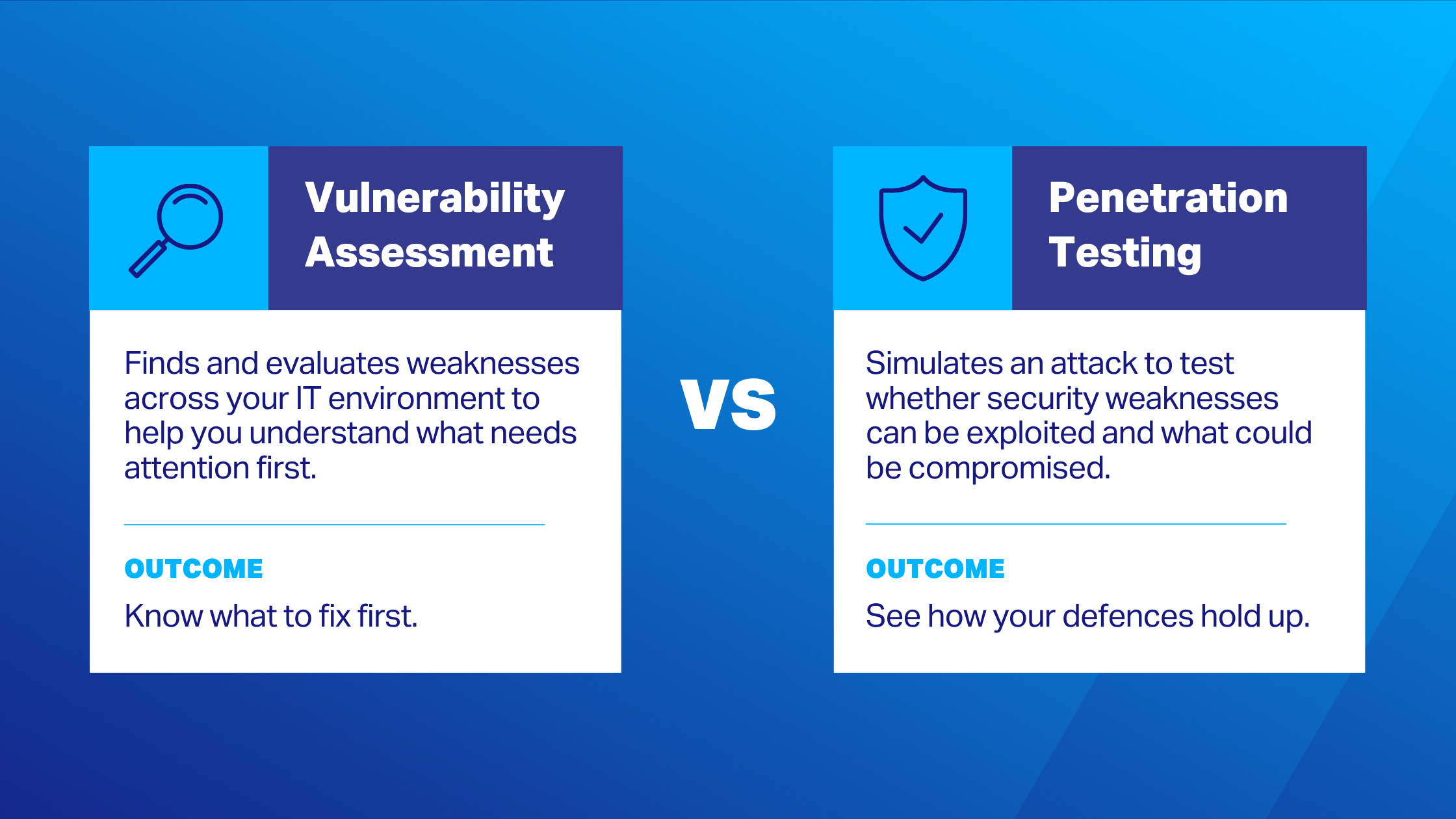
Vulnerability Assessments vs. Penetration Testing: What’s the Difference?
A vulnerability assessment aims to find, evaluate, and prioritize weaknesses in your environment. It takes a broader look at how systems are set up and secured, digging into areas like configurations, identities, access controls, and other security practices that can create risk. That’s different from vulnerability scanning—the always-on monitoring that should alert IT to red flags across devices, internet-facing assets, and other assets in real time.
A penetration test simulates how an attacker could move through your environment from an initial access point. The pentester actively follows potential attack paths to see what systems or data can be compromised.
“You can think of a vulnerability assessment as a home inspection,” adds Moncada. “A pentest is paying someone to break into your home to see how far they get before any alarms go off.”
When to Use a Vulnerability Assessment and Penetration Testing
Moncada recommends starting with a broad vulnerability assessment, then addressing the high-priority action items that surface. “This type of assessment should happen at least yearly, and it’ll show you the best places to move the needle forward on your security posture.”
Guidance from the Center for Internet Security calls for annual pentesting for certain organizations. However, Moncada sees the practice as more situational, particularly if your team has limited IT resources: “A yearly pentest can be a bit aggressive, depending on the environment.”
Because a pentest can also be expensive, it’s most valuable when done strategically. Rather than pentesting just for the sake of it—or before addressing the more obvious gaps that an assessment reveals—approach it as a form of quality control in the following situations:
Investigating specific areas of concern identified during a vulnerability assessment
Validating controls after a security uplift
Confirming that controls are working as intended after a major change, such as a cloud migration
Calbridge Homes offers a clear example of what an assessment-first approach might look like. After a shift to remote work significantly changed its security environment, the company partnered with IX Solutions to identify key priorities, including stronger endpoint security, MFA, and 24/7 monitoring. Once those improvements were in place, Calbridge followed up with a penetration test to confirm that the new controls worked as intended.

Proactive Security Starts With Visibility
Knowing where your security gaps are, and actively working to close them, is becoming more important as AI empowers threat actors.
Vulnerability assessments help prioritize improvements, while a penetration test checks whether those controls will actually work in a real scenario. The goal should be to make intentional improvements as your resources allow, rather than being able to defend against every sophisticated attack that makes headlines.
If you’re unsure whether you have enough visibility to take those first steps, an experienced partner can help you understand your exposure and determine what comes next. IX Solutions offers security consulting services to help your team build a more proactive strategy. Book a consultation with us today.
