
What Happens When Your Critical Systems Go Down? A Leadership Playbook for IT Outages

It’s a typical weekday morning at your company. Employees are logging in, customers are placing orders or submitting requests, and teams are relying on core applications to keep work moving.
Then, something shifts. Email slows to a crawl, key applications refuse to load, and shared drives or cloud platforms are suddenly unavailable. Critical information can’t be retrieved, and normal workflows start to break down across departments.
Within minutes, the helpdesk queue explodes. You turn to the IT team for clarity on what’s happening and how long it might last, while board members are starting to seek reassurance. What seemed like a minor glitch just minutes ago has become an org-wide emergency.
If you’re reading this while dealing with an IT outage, you’re not alone. And if not, it’s still worth preparing, because situations like this are on the rise. According to a 2025 survey from Cockroach Labs, 69% of companies face service interruptions at least weekly, with an average downtime of about 2.5 hours. Outages are also expected to become more disruptive, with software complexity, reliance on cloud providers, AI workloads, and even environmental factors all contributing to greater exposure.
Despite this, many organizations still lack a clearly documented and tested IT disaster recovery strategy. When systems go down, leadership may be forced to make high-stakes decisions in real time. This puts broader priorities, like financial stability, reputation, and regulatory compliance, at unnecessary risk.
That’s why a formalized business continuity plan is so important. When technical efforts and executive priorities are aligned in an official playbook, it can make the difference between total chaos and a coordinated response that protects operations, revenue, and stakeholder trust.
IT Outage: The First 60 Minutes
The first hour of an IT outage is all about clarity, containment, and delegation. While IT focuses on diagnosing and restoring systems, leadership must step into a broader role that extends beyond troubleshooting.
Very quickly, they become the organization’s de facto disaster command centre, responsible for continuity, communication, regulatory considerations, and financial impact. When preparation is lacking, that gap becomes immediately visible. Acting calmly and decisively under pressure here is a must, given that the first hour often sets the tone for the entire recovery effort.
Here are some questions you’ll likely need to consider early on as a CIO, executive, or other key decision-maker:
Incident scope and mapping:
Which systems, business functions, and users are impacted?
Is data integrity compromised?
Is this a network issue, a vendor failure, a cyberattack, or another type of incident?
Action plan and decision ownership:
Who is responsible for major decisions?
Which systems must be restored first to maintain operational stability?
Do we shut down operations to prevent further impact or try to limp along?
What restoration strategies are being activated?
Business continuity:
How long can we afford to operate without the affected systems?
What’s our estimated financial loss per hour of downtime?
What regulatory, contractual, or compliance obligations are triggered?
What do we communicate to key stakeholders, and when?
Where Organizations Fall Short
Gaps in IT disaster preparedness are more common than many leaders realize. Some organizations have set technical procedures but lack a business continuity plan that connects IT to broader goals and executive decisions.
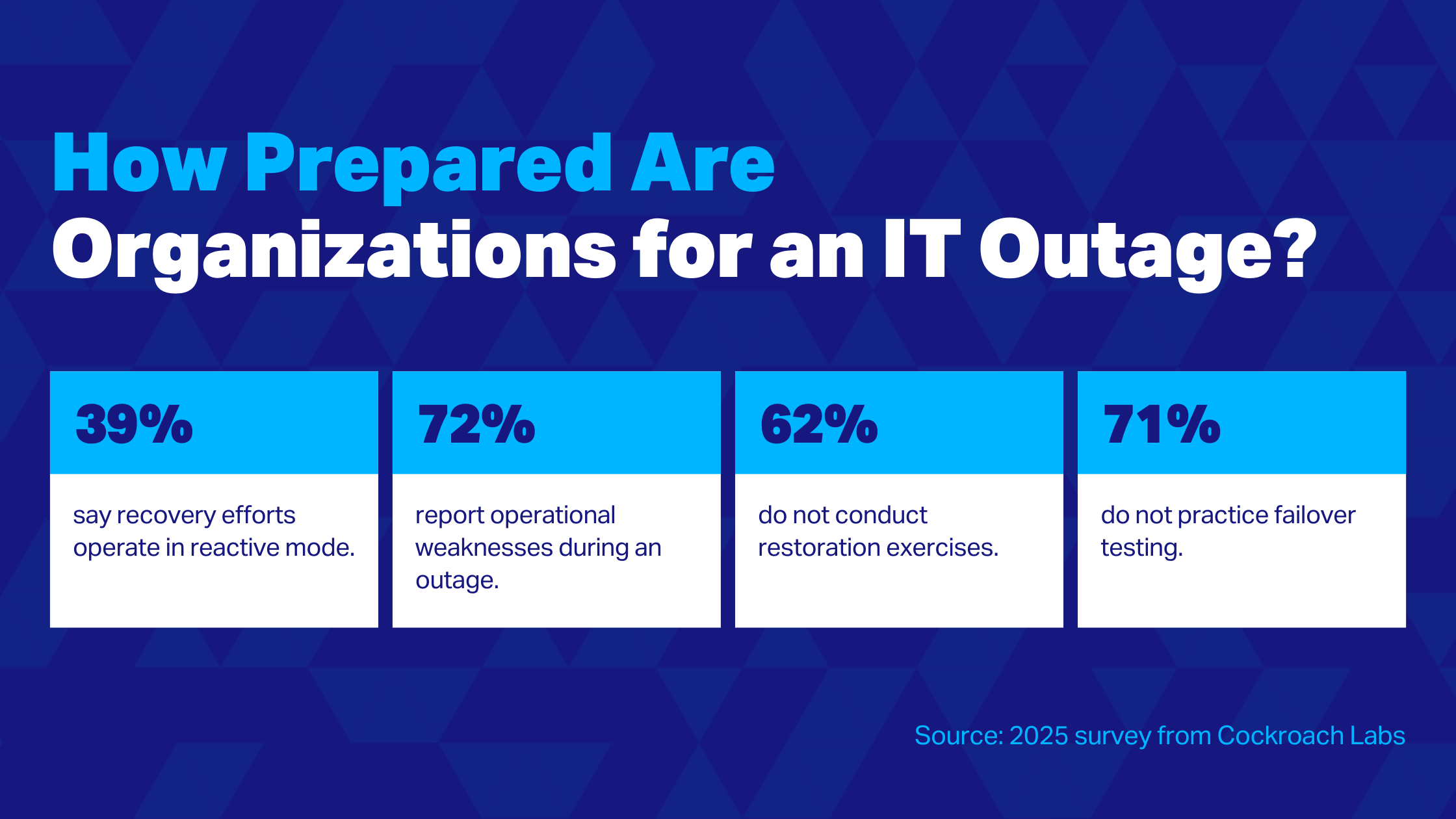
Others don’t have a playbook at all: 39% of executives told Cockroach Labs their recovery efforts are in full reactive mode. It’s not surprising, then, that nearly three-quarters (72%) say several operational weaknesses are holding them back from meeting both business and technical objectives during an outage. Without clear procedures, ownership isn’t well-defined, and repair can quickly become fragmented.
The same research highlights issues around testing. Sixty-two percent of organizations fail to do restoration exercises, while 71% don’t practice failover testing. When systems aren’t tested, downtime estimates are mere guesses. If restoration falters in an outage situation, IT teams could be forced to troubleshoot the recovery process itself, creating more delays.
These shortcomings are rarely intentional. More often, they stem from competing priorities or budget pressures. But if the goal is to be proactive and protect business continuity, restoration plans must be structured, tested, and clearly owned at the leadership level.
What a Leadership-Ready Recovery Plan Looks Like
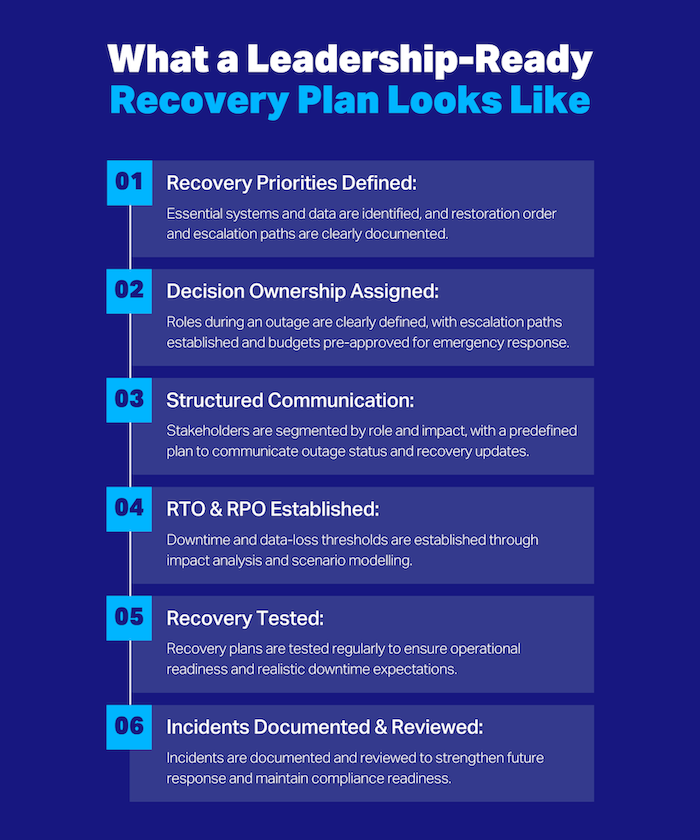
Explicit Recovery Priorities and Processes
Leadership must determine what software and data are essential for operations and in what order they should be restored. This requires a comprehensive inventory of your infrastructure and dependencies, along with an understanding of how systems support specific business functions.
An effective plan also documents specific steps and escalation paths to bring critical technology and data back online. These will vary based on your operations and infrastructure, but generally include:
Backup systems. IT may use a combination of approaches like secondary data storage, cloud-based recovery, disaster recovery as a service (DRaaS), or virtualization.
Redundant or failover systems. These secondary environments are designed to take over automatically when primary systems fail.
Manual workarounds. IT teams can document alternative, manual workflows to keep core operations working.
Primary environment restoration. Outlining how to transition back to the original production environment helps achieve normal operations faster.
Clear Decision Ownership
Too many hands on the steering wheel—or none at all—can create friction when an IT outage happens, extending downtime at the worst possible moment. A sound business continuity plan removes ambiguity, assigning responsibility for each part of the recovery process. Include specific IT roles, executives, business unit leaders, and any relevant vendor contacts here, spelling out escalation paths so each party moves quickly and predictably.
Decision ownership should also extend to financial authority. The middle of an outage is never a good time to negotiate funding, yet remediation often requires rapid spending on tools, third-party support, and other emergency costs. Approve budgets for these items in advance with the rest of the leadership team so you can focus on restoring operations rather than debating costs.
Stakeholder Communication Plans
Silence can erode trust faster than downtime. An effective plan outlines how and when you’ll communicate so customers, partners, employees, and regulators aren’t left in the dark. Timely updates reinforce confidence that the situation is being managed, even if systems are still coming back online.
Create an up-to-date stakeholder list segmented by role, impact, and required level of detail. Define what information will be shared, when initial notifications go out, how frequently updates are provided, and which channels will be used. Also, include backup communication methods just in case primary systems are unavailable.
Realistic Recovery Timelines
A business continuity plan isn’t complete without downtime thresholds:
Recovery Time Objective (RTO): maximum allowable downtime.
Recovery Point Objective (RPO): maximum tolerable data loss.
RTO and RPO should be set through an impact analysis involving leadership, IT, and finance. Scenario modelling for each business function will help estimate financial and operational risks more accurately, indicating how much disruption the organization can absorb. This allows you to make decisions grounded in objective data and avoid taking action too early or too late.
Keep in mind that RTO and RPO will vary by system and dataset. Your ERP platform, for example, will likely have different tolerances than a training portal or sensitive databases.
Regular IT Outage Testing
IT outage testing includes verifying backup integrity through controlled restores, measuring whether teams can meet RTO and RPO targets, and confirming that systems function properly once brought back online. Simulated outages and tabletop exercises are also helpful in familiarizing leadership with recovery workflows before a live event. The goal is to achieve confidence and clarity within the chaos, expose gaps early, and keep downtime estimates realistic.
Incident Documentation and Review
A playbook shouldn’t end when systems come back online. Without structured documentation and review, teams lose a valuable opportunity to learn and improve. As part of your plan, decide how incidents and their response efforts will be recorded in real time. When operations are back to normal, work with IT and other leadership to evaluate this documentation for blind spots, timing discrepancies, and other areas where the strategy should be updated.
Clear documentation also supports compliance. If data loss or mishandling intersects with regulatory obligations, having well-documented procedures makes audits far more manageable and can even help avoid costly violations.
The Value Of An Experienced Partner
Creating a solid plan—and executing it during a real outage—requires capacity, coordination, and specialized expertise. Internal IT teams are often running near their limits under normal conditions, and a major incident piles even more pressure on top.
This is where organizations often benefit from working with a managed services provider (MSP). Rather than replacing internal teams, the right partner strengthens them by contributing structured processes and additional capacity before, during, and after an outage.
An MSP can:
Design more resilient IT environments.
Provide an IT disaster recovery plan template.
Tailor a leadership-ready plan to your business.
Set and validate RTO and RPO targets.
Test and validate response strategies.
Keep documentation up-to-date.
Over time, investing in an external partner enables your organization to build operational maturity, helping CIOs, executives, and other core personnel tackle outages with confidence.
Prepare Leadership for the Next IT Outage
Outages are no longer rare, one-off events, but a recurring operational reality. The real question isn’t if disruption happens, but whether your organization is prepared to respond with clarity and control.
IX Solutions works alongside your team to design, test, and continuously strengthen recovery programs, aligning technical execution with executive priorities. If you’re ready to reduce uncertainty during IT disruptions, connect with us to evaluate your current recovery posture and build a plan that leadership can rely on.
